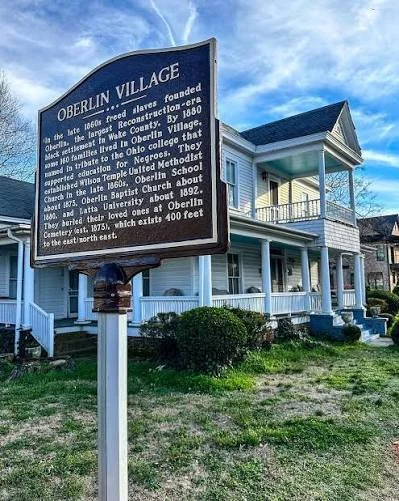
Oberlin Village was one of the largest self-sufficient, historically Black communities in North Carolina.
Oberlin Village
Raleigh, North Carolina
Oberlin Village was established in 1866 with an estimated 1,200 Black residents at its peak in the late 19th century. The community was rich in culture, home to numerous Black professionals, multiple churches, and schools. This thriving Black enclave was known for its high rates of property ownership and literacy.
Deed records show that beginning in 1866, lots were subdivided out of farmland and sold to the newly freed seeking financial freedom and stability. One of Oberlin Village's earliest and most notable residents was James H. Harris (1929-1891), a man born enslaved in North Carolina who gained freedom before emancipation and moved to Ohio. There, he attended Oberlin College and acted as a conductor on the Underground Railroad. During Reconstruction, he returned to his home state and served as elected official as a Raleigh city aldermen, in the state House of Commons, and at the state Constitutional Convention. It is likely his connection to Oberlin University that resulted in the naming of Oberlin Village, first noted in 1872.
Oberlin Village grew into a thriving Black neighborhood, home to many businesses, two schools, several churches, and significant land and home ownership. By 1880, the village census recorded approximately 750 residents identified as Black or Mulatto. The neighborhood continued to flourish after Reconstruction as an independent community for decades, until it was annexed by the City of Raleigh in 1922. In 1947, construction began on Cameron Village Shopping Center, named for the Cameron family, whose plantation was located nearby. By 1954, an Urban Renewal project to extend and expand Wade Avenue displaced many of Oberlin Village's Black residents, whose homes were destroyed. The Oberlin Road overpass, which spanned Wade Avenue, split the neighborhood in two, forcing more residents out and demolishing even more homes. After integration, the Raleigh school board closed Oberlin School, the only Black school in the district, further fracturing the community. Many Raleigh residents will remember the YWCA, now Interact, which stands in its place. For many years, the only outward reference to Oberlin Village was Oberlin Road, which runs right through the heart of the former community. One remaining landmark is Community Grocery at 901 Oberlin Road which opened in 1907 and still operates to this day.